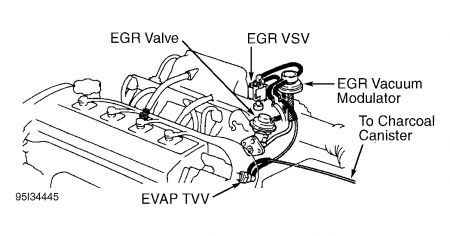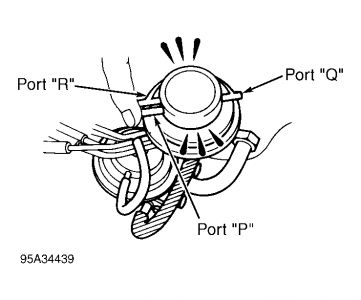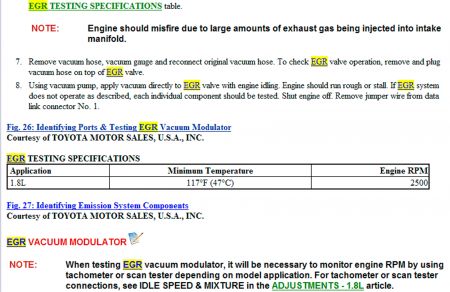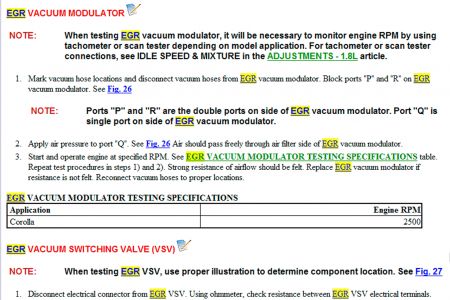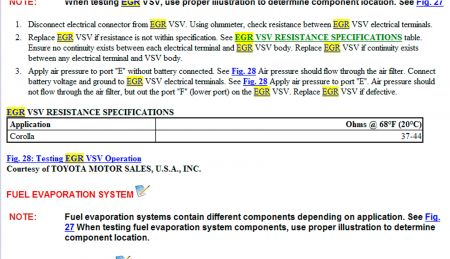
My 95 Corolla (1.8L, automatic, 150k) failed the NOx reading in the emission test. The HC, CO, CO2 readings were very good. I replaced the converter, back-flushed the engine, replaced the thermostat but it still failed. I took it to a mechanic but he was not able to find out what was wrong so I took it back after two days. I did a lot of bench tests and road tests (by introducing vacuum and voltage signals into the cabin), and found the EGR valve, the EGR vacuum modulator (regulator), the EGR solenoid vacuum switch, the Oxygen sensor, the temperature sensor for the computer and the temperature switch for the fan were all good. In the end, I found out there was no exhaust gas going into the EGR. I made an air tight connection with a tube into the exhaust outlet hole for the EGR at the intake manifold, revved up the engine and blew into it. There was little resistance other than that caused by the restriction of the small diameter of the tube itself. It seems there is a leak somewhere in the exhaust path before the EGR. I want to take down the intake manifold to take a look, but want to have some basic idea about what I might be dealing with before I start. Can someone tell me what may possibly be the problem? Is it likely located in the intake manifold, or likely to go beyond, at the engine head or the exhaust manifold? And what might it be--gasket or metallic part failure? Should I be prepared to buy another intake manifold or even the engine head? It doesn’t look like the exhaust was from the exhaust manifold but I simply have no idea where the exhaust came from. I have done many small car repairs but have not done anything this big.
A little more info about the exhaust leak: When I applied vacuum on the EGR, at 2 inch vacuum the engine rpm started to rise in proportion to the vacuum I applied. It continued to rise until about 8 inch then it wouldn’t rise anymore. Instead, the rpm went into a cycle of going up then down then up then down. It feels like the computer was trying to correct something that it detected but this resulted in a loop. By the way, the check engine light never came on. The rising rpm makes me think maybe the exhaust path was clogged somewhere and zero exhaust went into the intake, but on the other hand there might be a source that supplied air into the intake when the EGR was opened.
Also with this big job I am still not sure I will pass the test. A Toyota mechanic said that at 15 or 25 mph the EGR need not come on. Could someone confirm that the EGR should be on at 15 mph, cruising?
Any help would be greatly appreciated!
A little more info about the exhaust leak: When I applied vacuum on the EGR, at 2 inch vacuum the engine rpm started to rise in proportion to the vacuum I applied. It continued to rise until about 8 inch then it wouldn’t rise anymore. Instead, the rpm went into a cycle of going up then down then up then down. It feels like the computer was trying to correct something that it detected but this resulted in a loop. By the way, the check engine light never came on. The rising rpm makes me think maybe the exhaust path was clogged somewhere and zero exhaust went into the intake, but on the other hand there might be a source that supplied air into the intake when the EGR was opened.
Also with this big job I am still not sure I will pass the test. A Toyota mechanic said that at 15 or 25 mph the EGR need not come on. Could someone confirm that the EGR should be on at 15 mph, cruising?
Any help would be greatly appreciated!
Sep 8, 2007 at 8:52 PM